emin@budak ~/blog % cat muse-spark-open-deployment.md
Muse Spark Open: The Costly Open-Weight Bet

Muse Spark Open is an open-weight model aimed at agentic coding, but its 816B total parameters make deployment the real story. Meta’s October 15 release combines a 1M-token context window, text and multimodal input, and sparse routing that activates about 42B parameters per token. That sounds like a model that can fit more work into a single agent session. It is also a reminder that active parameters are not the same as the memory footprint an operator must provision.

Contents
Muse Spark Open changes the open-weight agent conversation
Muse Spark Open changes the conversation because it exposes a frontier-scale agentic model without making the serving problem disappear. Meta describes it as a natively multimodal mixture-of-experts model built for coding and long-running tool use. Its public model card lists text, images, audio and video as inputs, with text output and a 1M-token context window.
The immediate attraction is clear. Coding agents do not live on a neat prompt and a neat answer. They read repositories, inspect logs, call tools, recover from failed tests and carry decisions across a task. A longer window can reduce how often a harness throws away useful state or asks a model to rediscover it.
The release also has real distribution value. The weights are available through Hugging Face, with recipes appearing across common serving stacks. That gives infrastructure teams more control over placement, data handling and post-training than a hosted-only model does. It does not make the model a laptop download in the ordinary sense.
Why Muse Spark Open active parameters are not the whole deployment number
The 42B active figure describes compute per token. The 816B figure still describes the model that must be stored, loaded and routed. Muse Spark Open has 256 experts per MoE layer and selects eight for each token. Sparse routing lowers the arithmetic work, but the inactive experts do not vanish from the cluster.
This is the distinction that matters most in planning. Teams often use active parameter count as a rough performance proxy, then accidentally use it as a capacity estimate. Those are different questions. Compute per token affects latency and throughput. Resident weights, communication topology and the KV cache determine whether the service can start, batch work and survive a busy queue.
| Question | What the release suggests | What to verify before deployment |
|---|---|---|
| Token compute | About 42B parameters are active per token | Latency and throughput under the intended batch size |
| Weight storage | All 816B parameters remain available to the router | Memory format, sharding plan and restart time |
| Context | Up to 1M tokens share one multimodal window | KV-cache limits, admission control and eviction policy |
| Expert traffic | Eight of 256 experts are selected for each token | Interconnect behavior and expert-load balance |
The Hugging Face technical write-up makes the trade-off concrete: it puts the BF16 checkpoint at about 1.5 TB. It also describes an NVFP4 checkpoint aimed at NVIDIA Blackwell hardware. Compression changes the practical shape of the problem, but it does not turn an 816B model into a 42B model. It changes the storage and bandwidth budget, then introduces accuracy and runtime questions that need their own evaluation.
The 1M-token context window moves pressure into the cache
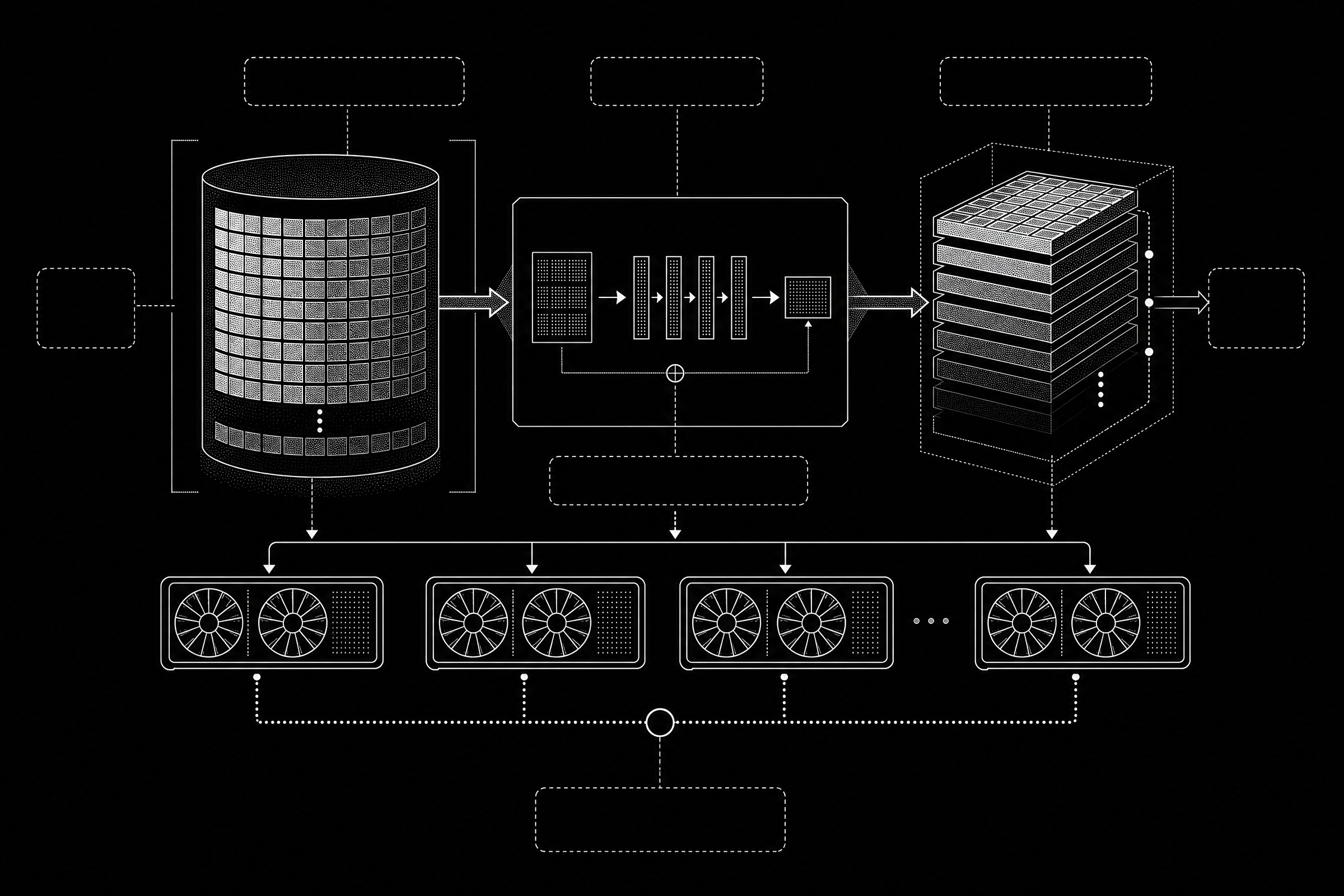
A 1M-token window is useful only if the system can afford to keep it. The model’s grouped-query attention keeps the cache smaller than a full multi-head design would, but it does not make it small. The Hugging Face analysis estimates roughly 250 KB of KV cache per token in BF16, or about 266 GB for a full 1M-token context.
That number deserves more attention than the launch benchmarks. A single agent may rarely consume the full window, but production systems do not run one ideal request. They run many tasks with different prompt lengths, retries and tool traces. The hard operational problem is admission control: how much context can enter before tail latency and out-of-memory failures make the agent less useful than a smaller model with a firm budget.
There is a better default than treating 1M as an entitlement. Set task-level context ceilings. Keep retrieval and compaction as first-class parts of the harness. Measure cache growth by task type. Reserve the largest window for a repository migration, an incident investigation or a multimodal debugging session where the evidence genuinely needs to stay together.
The right Muse Spark Open deployment starts with a workload, not a benchmark
Muse Spark Open looks most compelling where a long sequence of tool calls depends on shared context. A large repository task, a code review that spans generated artifacts, or a debugging session that mixes logs, screenshots and screen recordings are plausible fits. A short completion request is not. Sending it to an 816B routing system just because 42B parameters are active would be an expensive way to answer a small question.
There is also a licensing detail that should be read before adoption, not during procurement. The model card and license set conditions for use and distribution. Open weights mean the checkpoint is accessible. They do not mean every product integration has no obligations.
The first engineering experiment should be narrow. Pick one agent workflow with a real failure mode: repository-wide edits that lose context, multimodal bug reports that are split across tools, or long test-fix loops. Run it against a smaller serving baseline. Record completion quality, time to first useful action, total tokens, peak cache use and failure recovery. The model earns a permanent place only if those results justify the operational weight.
For teams already working through the limits of local large-model inference, Muse Spark Open sharpens the same lesson. Sparse models can lower compute per token without lowering the systems work. That is not a flaw. It is the design constraint worth understanding before the model becomes a dependency.
Read Meta’s release announcement, the technical architecture walkthrough, and NVIDIA’s deployment notes before committing a cluster. The release is significant. The deployment math is the part that decides whether it is useful.